
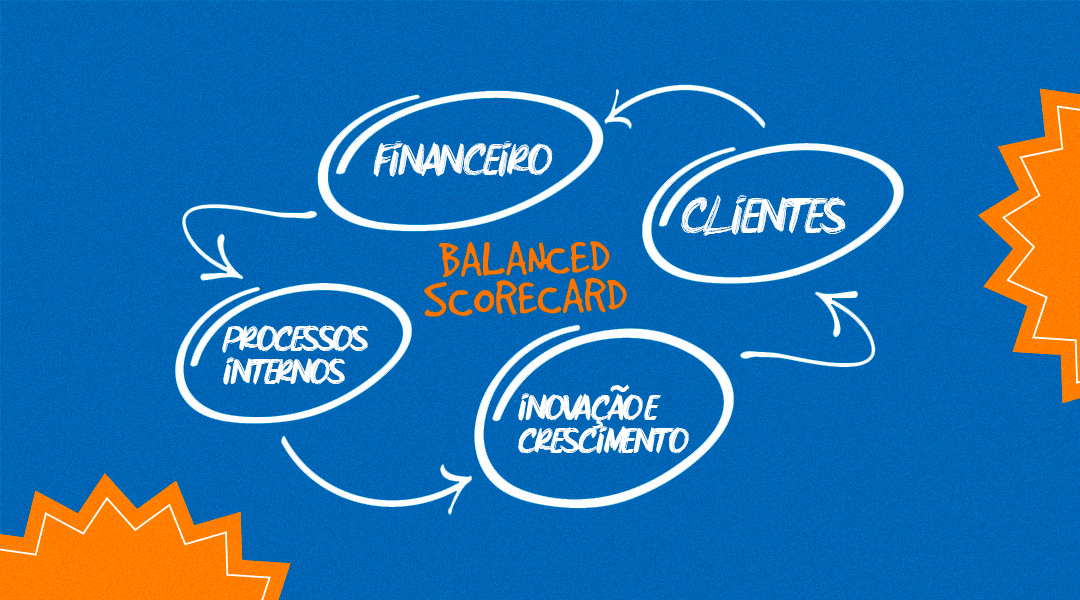
For people management to work efficiently within an organization, it is necessary to make use of certain tools and strategies, such as the Balanced Scorecard, also known by the acronym BSC.
With this methodology, companies are able to increase their performance and track their objectives, accelerating their results. In this way, it allows for a strategic visualization of the workflow and its long-term progress.
As well as other methodologies that have already been presented here, such as: Kanban, 9-box matrix, Gamificationamong others. We will cover the concept of the BSC, from its origin to its applicability for more strategic and practical management.
So, read on and enjoy the content!
What you'll see:
- What is the Balanced Scorecard?
- What are the strategic elements of the Balanced Scorecard?
- How does the Balanced Scorecard work?
- What is the importance and benefits of the BSC?
- How to apply the BSC methodology in your company?
What is the Balanced Scorecard?
The concept originated in 1992, when David Norton e Robert Kaplan, together formulated an article on their own methodology for measuring results and defining strategic goals.
The main objective of the proposal was to evaluate important points in the business, not just certain metrics, but its performance as a whole. The article was entitled: "The Balanced Scorecard: measures that drive performance"and has specific points to consider.
This methodology has become a strategic management model, taking into account the measurement of progress, goals, planning, among other things. It is a technique for balancing the main performance indicators of a company's existing projects, from start to finish.
The term also refers to something like "Balanced Performance Indicators", which can represent a major improvement in results, helping to show what has and hasn't worked within the organization.
Thus, with the implementation of the BSC, it is possible to consider four perspectives: financial, market (customers), internal processes and learning/growth .
Below, we'll look at each of these perspectives and their variables. Follow along!
What are the strategic elements of the Balanced Scorecard?
The BSC can be defined by its vision and strategy, which seeks to measure business variables in order to monitor progress. In this context, four key perspectives are defined:
Financial perspective
In the financial perspective, questions related to the impact that decisions about and investments have on achieving the and objectives of the business.
In this way, it is possible to relate how investors, shareholders and customers see the company, so that from there you can draw up a strategic financial plan that results in their satisfaction with good results.
This is where financial indicators are evaluated, such as gross sales, average sales price, average ticket, ROI, among others. With these metrics it is possible to see whether the company is achieving the results it expected and how it can succeed and increase its profits.
Market perspective (customer)
With the market perspective, the company evaluates the customer satisfactionIn other words, it can start researching which relationship objectives with its public have been achieved.
This evaluation is directly linked to the financial perspective, as it reflects the results achieved through profitability. Here, aspects such as loyalty, satisfaction, reputation, shopping experience, among others, are the main indicators of this process.
Another important point to consider is the market, evaluating strategic points for business growth and expansion.
Internal Processes Perspective
As each perspective is directly linked to the other, it is necessary to understand that in order to achieve each of them it is necessary to work on fundamental actions with regard to the internal processes of the organization.
So, what actions need to be taken if the business is to succeed and the objectives are to be achieved? In practice, this means that the focus must be on the quality of the operations that need to be carried out.
Indicators such as team productivity, quality of service\product, after-sales service, among others, are the focus for implementing improvements and repairing possible errors.
Learning and Growth Perspective
As with all quality strategic planning, a very important step for its success is to be able to empower and train the team to achieve the goals and objectives set.
In this context, the organization must evaluate intangible assets that are related to the satisfaction and retention of its human capital. Some essential indicators for this perspective are turnover, feedback managementengagement, employee experienceamong others.
With this perspective very well defined, the organization will be able to add value and improve its reputation by combining basic principles with the company's organizational culture.
Now that you know the concept of the Balanced Scorecard and its four perspectives, understand how this methodology works!
How does the Balanced Scorecard work?

It's time to understand how this strategic methodology works so that you can put it into practice. Follow along!
In addition to the 4 perspectives of the BSC, there are also 4 important and fundamental topics for its operation, which are:
-
Strategy map
After gathering and defining the strategic elements of the BSC, it's time to clearly establish the actions and initiatives that will be the business's mission.
Creating the strategy map will help to give direction to the projects that need to be implemented, i.e. it will be through this topic that the organization will be able to structure its planning.
The purpose of the map is to facilitate the flow of information pertinent to the company's mission, vision, values, objectives and goals, in a very transparent and easy-to-view way, accessible to everyone and thus facilitating internal communication between teams.
This will make it possible to structure the company's strategies quickly, simply and functionally.
-
Objectives
Establishing the strategy's objectives is the key to successful planning. This is because it is necessary to know how to define the objectives in such a way that they can be achieved.
Objectives need to be achievable, audacious, but real. Therefore, part of the process of motivating and engaging employees involves setting flexible goals, precisely so that there is no frustration and demotivation throughout the cycle.
This means that establishing the objectives of each perspective is essential for the smooth running of the organization.
Define the objectives and align the actions with the available resources, communicating the goals to all the areas involved.
-
Indicators
Indicators help to visualize the company's performance. They show how each action has been carried out and when there is a need for adjustment or intervention.
Aligning the indicators is fundamental to being able to monitor each stage of the BSC process and measure the possible changes required.
A good example of monitoring indicators is that of customer satisfactionwhich can indicate whether the strategy being used has been successful or whether strategic planning needs to be revised in order to achieve the expected result.
Monitoring the performance of each objective set is essential to achieving good results. Indicators therefore play an important role in developing a quality BSC.
-
Goals
The targets represent the level of performance of each of the indicators, outlining a plan for achieving individual and collective goals.
In general, targets facilitate the process of quantifying the performance of each objective proposed within the initial strategic planning.
Anyway, as you can see, implementing the Balanced Scorecard in your company is a task that requires strategic vision and the integration of different sectors so that the planning can be as complete as possible.
The BSC is a tool that helps in the strategic management of the company in a clear and efficient way, consolidating a business model that has been widely worked on and developed in different segments and sizes of companies.
In this way, the strategy manages to remain current and beneficial for the organizations that use it. Understand the main benefits of this concept.
What is the importance and benefits of the BSC?
Organizations that apply the BSC methodology are able to achieve very significant results in their business. That's why we've listed some of the main benefits of adopting this model in management.
But before pointing out the benefits, it is essential to talk about its importance, since the tool is essential for managing the organization's strategies.
The proposal is quite simple: to unite actions and strategies to achieve objectives. As a result, all sectors of the company are affected and short-, medium- and long-term goals can be set.
When a company adopts the BSC methodology, it gains a broad vision of how to achieve its objectives efficiently and starts to better align its actions based on real, measurable indicators.
Through the BSC, the advantages can be:
Improves strategic vision
With a visualization of all the organization's key indicators and clear monitoring of strategies, it becomes easier to define the necessary action plans.
In order to improve and transform results, it is necessary to be clear about the goals and to be able to monitor them in a transparent, objective and specific way, which is what makes it possible to have a macro perception of the objectives.
Facilitates communication between teams
Knowing where you want to go is one of the main steps towards achieving the desired result, and in this case, it is essential that everyone involved is aligned and speak the same language.
This way, making the team aware of what has been done and what needs to be done will make it easier for all the other processes to take place.
By using the BSC methodology, not only can managers monitor progress, but employees can also see each stage and thus improve the quality of their deliveries.
In this scenario internal communication is the key to spreading the organization's objectives and goals and thus achieving the desired results.
Aligning strategies
With the BSC it is possible to work out the company's objectives from the strategy mapwhich helps to implement the idea within the organization, with the actions that must be carried out.
Adopting this methodology therefore facilitates the alignment of strategies and better information management. With the whole team involved in the project and aware of their role in the smooth running of strategic actions, it is expected that everyone will be able to visualize the objectives and move towards the same goal.
Building a joint action plan is what will ensure that all areas of the organization are aligned and in perfect harmony with its objectives and goals.
Continuous improvement
A competitive advantage over other companies is undoubtedly the possibility of continuous improvement through the constant renewal of strategies and action plans. And all this to ensure that they best meet the company's needs and demands.
This constant improvement is the result of real-time monitoring of indicators and metrics. And this is what makes it possible to measure the performance and scope of what has been done within the organization.
The idea is to ensure that repairs and adjustments are made so that quality increases as targets are met. Periodic reviews are what allow progress to be made dynamically, thus building a well-structured and efficient continuous improvement cycle.
How to apply the BSC methodology in your company?
Now that we've gone through the whole concept behind the BSC methodology and delved into its benefits, it's time to learn how to implement the tool in your business.
The way in which the balanced scorecard manages to be objective and up-to-date within the market is what makes it the perfect tool. And all this because the focus of the methodology is on achieving a broad, long-term vision of the business.
The BSC manages to bring together the company's tangible and intangible indicators in one place, so that they can be analyzed together and not just from a financial perspective, for example.
Considering that the organization's objective is to align its sectors and be able to follow its processes in order to achieve successful results, the step-by-step approach would be:
List your actions and create a strategy map
This moment is crucial for the functioning of the BSC, gathering pertinent information about the company to be able to define where it is necessary to invest at the moment.
It's interesting to understand what the organization's main needs are and what would be essential to achieve better results. A good example might be companies that don't have an integrated system for their employees to help with the IDP and facilitate decision-making.
As such, there is a need to adopt more dynamic, automated and efficient management. And in order to do this, it is necessary to use tools that promote this objective, in other words, this is one of the points that needs to be included in strategic planning.
The strategy map needs to bring together a clear vision of what the company wants to achieve and what resources it will use to do so.
Inform everyone involved about the strategies and objectives
With the plan in hand, it's important to inform employees of the strategies and objectives the company wants to achieve. Aligning the objectives and targets with the team is what will guarantee everyone's adherence and engagement.
Regardless of whether the company in question is small, medium or large, it needs to work on the BSC by communicating its steps and integrating its team into each stage of the process.
Define the metrics and indicators that will be worked on
In order to follow strategic planning efficiently, it is important to have clear indicators. In this way, it will be possible to monitor and metrify the results, checking what is and isn't working within the strategy.
In order to make assertive decisions, it is necessary to base them on specific information and indicators. Therefore, defining indicators is part of how the BSC works.
Promote constant and horizontal feedback
The flexibility that the BSC gives the company is what makes it possible to make the necessary changes throughout the strategic process. And this only happens through continuous feedback that are carried out with the whole team.
It is through feedback that improvements can be implemented and management can strategically assess what needs to be improved, based on performance metrics.
Always monitor and follow up the results!
Invest in technological tools
Despite building an efficient and quality strategic plan, bringing together all the necessary perspectives, if there is no investment in the right technological tools, progress will be much slower.
In fact, associating strategies with platforms and tools that make processes easier and bring dynamism, speed and fluidity to projects is what can set your company apart from others.
That's why we offer the most modern and advanced software on the market, Jano! Here you can build and define your goals and objectives according to the strategic plan you choose, aligning expectations and making follow-up much more organized and easy to measure.
Translate your strategy into operational terms with the Jano platform and transform your results. Talk to an expert right now and schedule a demo! Click here.