
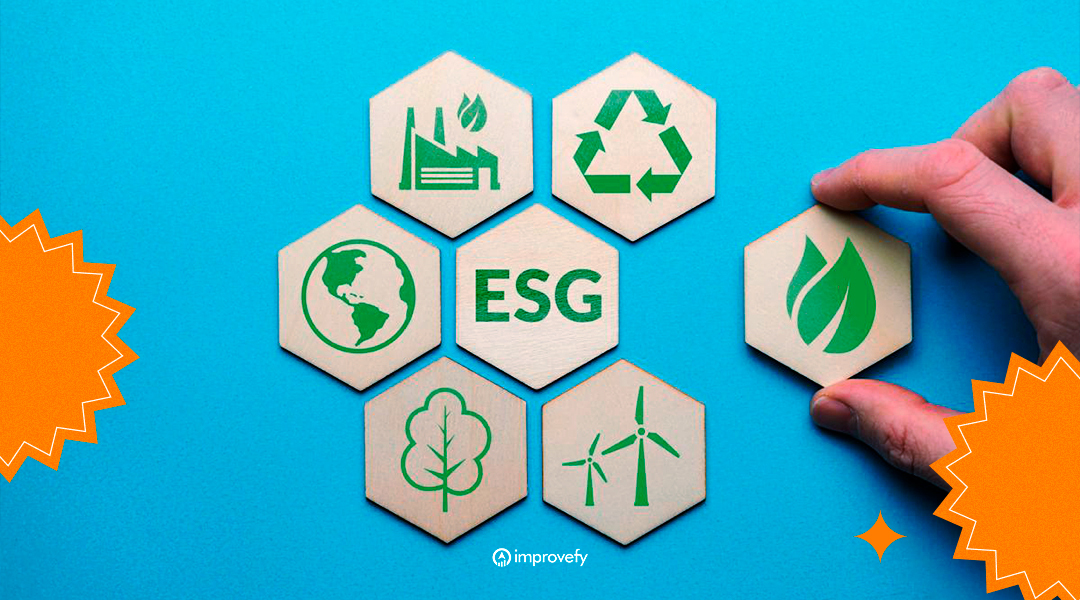
O ESG has become a driving force within organizations and to keep up with this trend it is necessary to be aware of the key ESG criteria for HR. This is because your focus must be on the expanding market and the new corporate opportunities of the future.
Therefore, a management model that adopts sustainability practices in line with its business strategy proves to be efficient in establishing a competitive advantage over its competitors.
In fact, it's interesting to understand what the role of HR in ESG culture culture and how this rise in the subject is shaping the new HR more and more every day, working to measure and define the indicators that are so important for building a company with ESG management standards!
In the article, we will explore which indicators management should analyze in order to begin its commitment to the ESG agenda in a responsible and promising way.
You'll see:
- Promising relationship: how can HR put ESG policy into practice?
- How does ESG generate value for companies?
- Learn about some ESG criteria for HR
- Avoid these mistakes when measuring ESG indicators
- How Improvefy can help promote ESG management in your company
Promising relationship: how can HR put ESG policy into practice?
Perhaps there are still some questions and doubts about the importance and relevance that HR can have on ESG practices. But it is necessary to understand that those responsible for people management within an organization are the same people who can help implement the ESG methodology in order to achieve the best results.
It is therefore essential to be able to monitor and develop the processes by which HR relates to sustainable principles. And once this relationship is made, everything becomes more connected and its positive impacts can be better visualized.
It is HR that will define, for example, which strategies will be used and prioritized so that issues in the social, environmental and environmental and governance issues follow a line that makes sense. And that they are internalized by everyone on the team, from leaders and managers to investors, employees and customers.
The role of HR at this time will be to be able to position itself efficiently and consciously, promoting actions that reflect the idea of ESG not only in something specific, but also in the company's daily routine.
In this regard, it's also important to mention that HR is directly linked to ESG practices, during the process of designing and creating new vacancies and carrying out hiring that focuses on diversity, promoting real opportunities.
In this way, it is possible to include and embrace different genders and ethnicities. Therefore, it really is a culture focused on promoting effective change and not just a discourse.
And when the necessary tools are provided to encourage and stimulate significant changes in the company's organizational culture, it is possible to see plural and diverse hiring. And this, in turn, has a direct impact on the social pillar of these issues.
An organization that decides to take the path towards the future of the market needs to prepare itself not only by drawing up strategies and actions, but also by directing its investments and resources towards mapping out the best opportunities.
And to integrate the journey of this work with everyone in the company, promoting a culture that respects every aspect of the environmental, social and governance pillars. of the environmental, social and governance pillars.
For everything to go according to plan, there are different issues that need to be addressed and defined with the help of management. In this process, it is essential for HR to set up and define what their ESG agenda will look like and create a complete manual on good practices, which also addresses the ESG criteria they will follow.
This material should initially be distributed to all employees and new hires. In this way, everyone will be aligned with the same objectives and goals and will have the necessary knowledge to follow the agenda.
This makes it easier to understand how issues will be dealt with and what direction the company will take. The organization is able to transform its employees' and customers' perception of the brand and show itself to be efficient as a new HR with an eye on the future!
How does ESG generate value for companies?
With the public becoming increasingly committed and involved in social and environmental causes, it is to be hoped that companies and organizations have already understood that they need to take this issue more seriously. Standing out in the market and adding value to your business are the result of how ESG measures can positively impact a company's image.
But why is that?
The answer is not something ready-made, but can be understood through certain themes that the ESG addresses, such as:
- Crisis and climate change;
- Employees' quality of life in times of COVID-19;
- Transparent management;
- Reduced emission of gases and pollutants;
- Supporting diversity and inclusion in business;
And so many other fundamental issues for building a process of transparency and trust between companies, investors, the public and consumers.
But how exactly are ESG measures positive and beneficial for the organizations that adopt them?
In general, with socio-environmental and sustainability policies, it is possible to reduce operating costs with more conscious consumption measures. In addition, it creates a competitive advantage when it comes to investments and financing, since these practices are often already linked in some way to ESG policy.
Whether a company is public or private, and from the most diverse segments, social influence and responsibility already dictate the "rules of the game". It is therefore essential to stay ahead of the curve and keep up with this new market reality, thus adding undeniable value to the company.
And in order for this to happen consistently and with quality, it is essential to follow certain steps to devise the most appropriate strategy for each company's reality.
Therefore, knowing and understanding the main ESG criteria for HR is the golden rule for being able to align social, environmental and governance purposes. Read on and find out more!
Learn about some ESG criteria for HR

In order to manage an organization efficiently, including and aligning its culture with ESG policies, HR needs to base itself on certain metrics and indicators based on environmental, social and corporate governance criteria.
Some of these criteria serve to make up ESG trends and should therefore be included in the company's planning for its future actions. The main ones are:
- Diversity and Inclusion
- Customer satisfaction
- Employee engagement and motivation
- Wage policy
- Health and safety
- Discrimination and harassment
- Biodiversity
- Air pollution
- Impact of water pollution
- Anti-corruption
- Risk management
- Protected ethical advice
Within these metrics, some criteria must be worked on, such as:
- Culture - In order to create new market opportunities and attract more and more investors, organizations need to adopt ESG measures into their internal culture in a broad way, disseminating and sharing their values both internally and externally.
- Monitoring - It's not enough just to say that the company is now based on ESG principles, but that it must apply them effectively and monitor their results. In other words, monitoring and analyzing the impacts of socio-environmental measures.
- People management - Defining the teams that will be responsible for propagating and taking ESG practices forward within the organization is very important in order to validate everything that has been planned within this strategy. In this way, the ambassadors for ESG practices will be the company's spokespeople.
- Strategies - It is necessary to have a strategic plan for each ESG pillar. This will help to better define the actions taken, as well as which indicators should be analyzed to monitor the progress of the measures implemented..
- Partnerships - These days, the strategies that are most likely to succeed are precisely those that involve partnerships. Therefore, looking for partners such as social and environmental NGOs to strengthen the ESG culture in the organization is an excellent initiative.
Finally, it is essential to mention that for these actions to be most effective within the organization, HR needs to be strategic and understand the paths it needs to take to put the ESG agenda into practice.
And in this way, focus on the challenges that this policy demands and conquer a market that is increasingly looking to the changes and innovations of the future.
Avoid these mistakes when measuring ESG indicators
It's no coincidence that large companies and organizations in various sectors have been adopting the social and environmental practices of the ESG methodology for some time.
And all of this is due to the great results it can bring about in the medium and long term, with sustainable investments and increasingly careful measures to environmental, social and governance issues.
It is therefore worth highlighting the importance of following the ESG criteria for HR and the most common mistakes that should be avoided.
Not betting on technology for your strategy
The platforms and tools available on the market for this purpose can and should be used in favor of your ESG strategy. By ignoring these resources, management tends to pass on ESG indicators and criteria to HR in a superficial way or even more laboriously than it should be.
It is therefore very important to use the software available on the market to help with this work. It's important to note that currently, there aren't many resources for this purpose, but gradually this reality is changing as ESG policy advances in the market.
Measuring results in a shallow way
It's important to focus on presenting relevant data and understanding its causes!
Oi.e. prioritizing the way in which the work will be done and its objectives and not just on possible results or promises, but on what is actually essential for the success of the strategy.
In this way, there is no way to ignore the processes, but rather to consider all the work carried out and the circumstances that led to the results obtained.
Only worry about data that is easy to measure
Even if some data is easier to measure than others, that doesn't mean it's more important. That's because perhaps the complexity of gathering the results and tracking the metrics is a small sample of how important a particular ESG criterion is for HR.
In this context, being able to understand and analyze why results on issues of diversity and inclusion may be more relevant at certain times, for example.
This is because companies that are more open to the diversity of their human capital are more innovative, creative and capable of attracting and retaining talent.
Finally, management is responsible for incorporating the necessary processes into the program and internalizing these issues into the organization's business. In this way, it is possible to measure the impact that these actions will have in relation to the expected results.
How Improvefy's solutions can help promote ESG management in your company
One question that has guided all the work and effort to promote solutions to meet our clients' ESG measures has been: cow could we help other companies focus their objectives on ESG practices?
Based on this premise, Improvefy set out to offer the tools needed to carry out this ESG goal management work in a simple, transparent and organized way.
Thus, the ESG Management module was born with several features that will help its users achieve their objectives and monitor the ESG target indicators divided into each of the pillars.
And all this with the aim of implementing ESG strategies at the tactical-operational level of the organization, helping to strengthen the company's new culture and achieve its objectives and goals.
And to that end, our module is made up of a number of tools that help with the administration, control and organization of ESG practices.
Some of these are Fulfillment workflow, Incident management, Audit trail, ESG dashboard, among others.
Do you want to facilitate the process of implementing ESG practices in your company?
So, take an ESG Management maturity assessment right now to identify what stage your company is at. From there, we'll formulate a strategy for the best development and immersion in the ESG universe.
Get to know Improvefy and become an ESG company yourself!